Fewer people
on site.
More sites live.
A guided handheld the GC carries through the sectors. The integrator stays at the desk and reads the live results — telling the GC exactly what to fix on the spot. Swapped antennas, loose fibers, mis-aimed sectors — caught before the crew leaves.
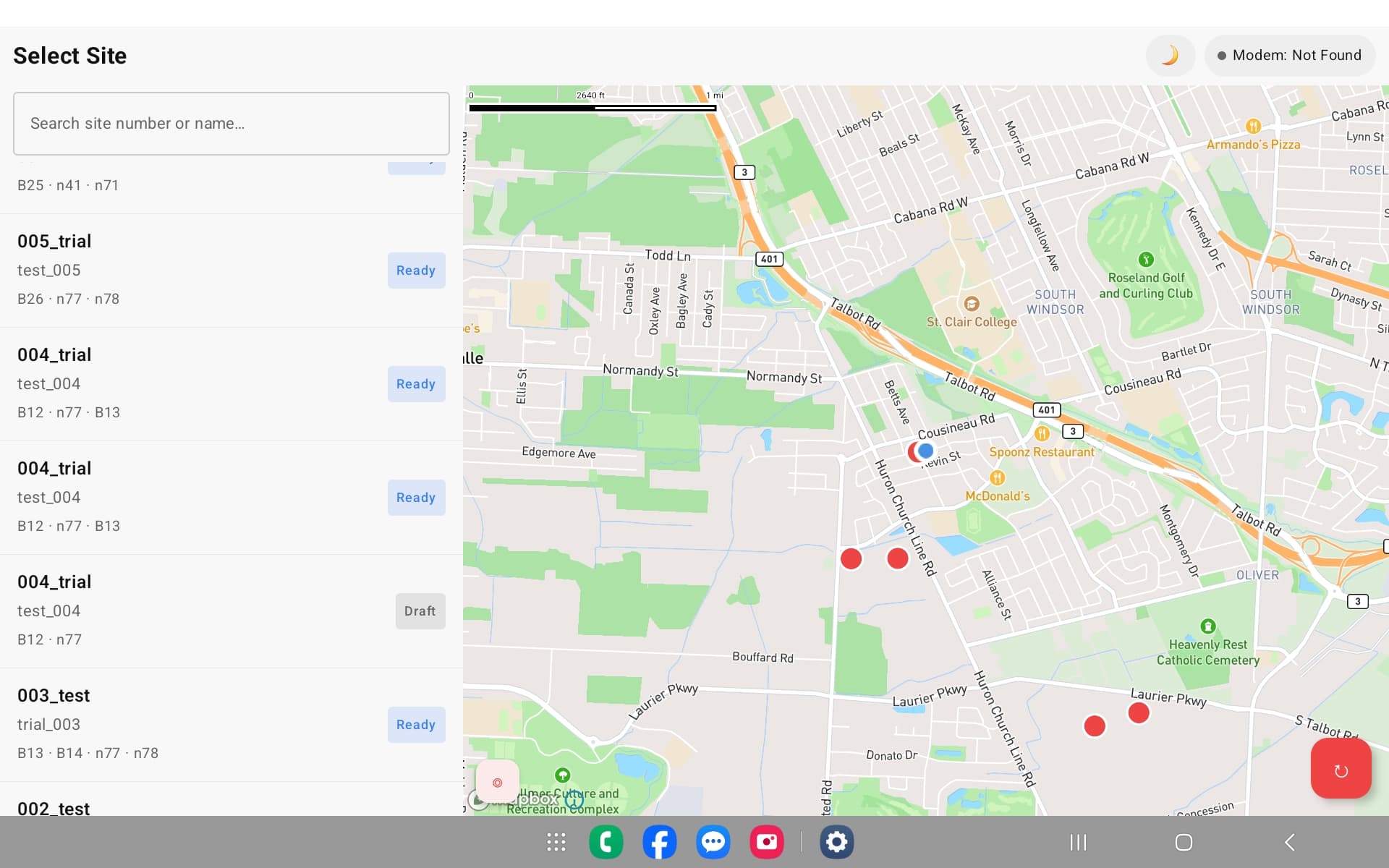
Three steps. Anyone on the crew can run them.
The portal sets up the site once. After that, every commissioning walk is identical, automatic, and self-documenting.
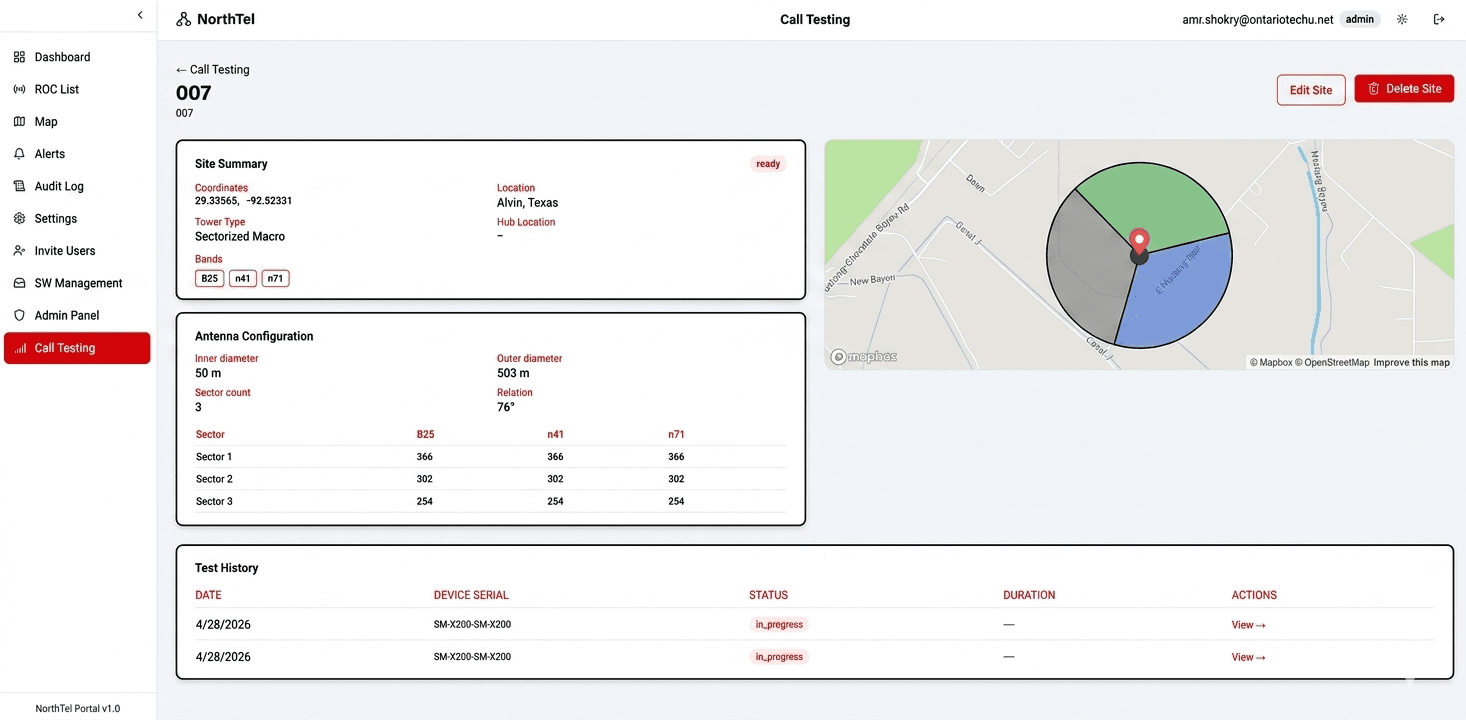
Integrator sets up the site once.
From the desk: drop a pin, pick the tower type, set bands and PCIs per sector. The portal generates the coverage geometry — inner radius, outer radius, sector rotations — that will guide the GC's walk.
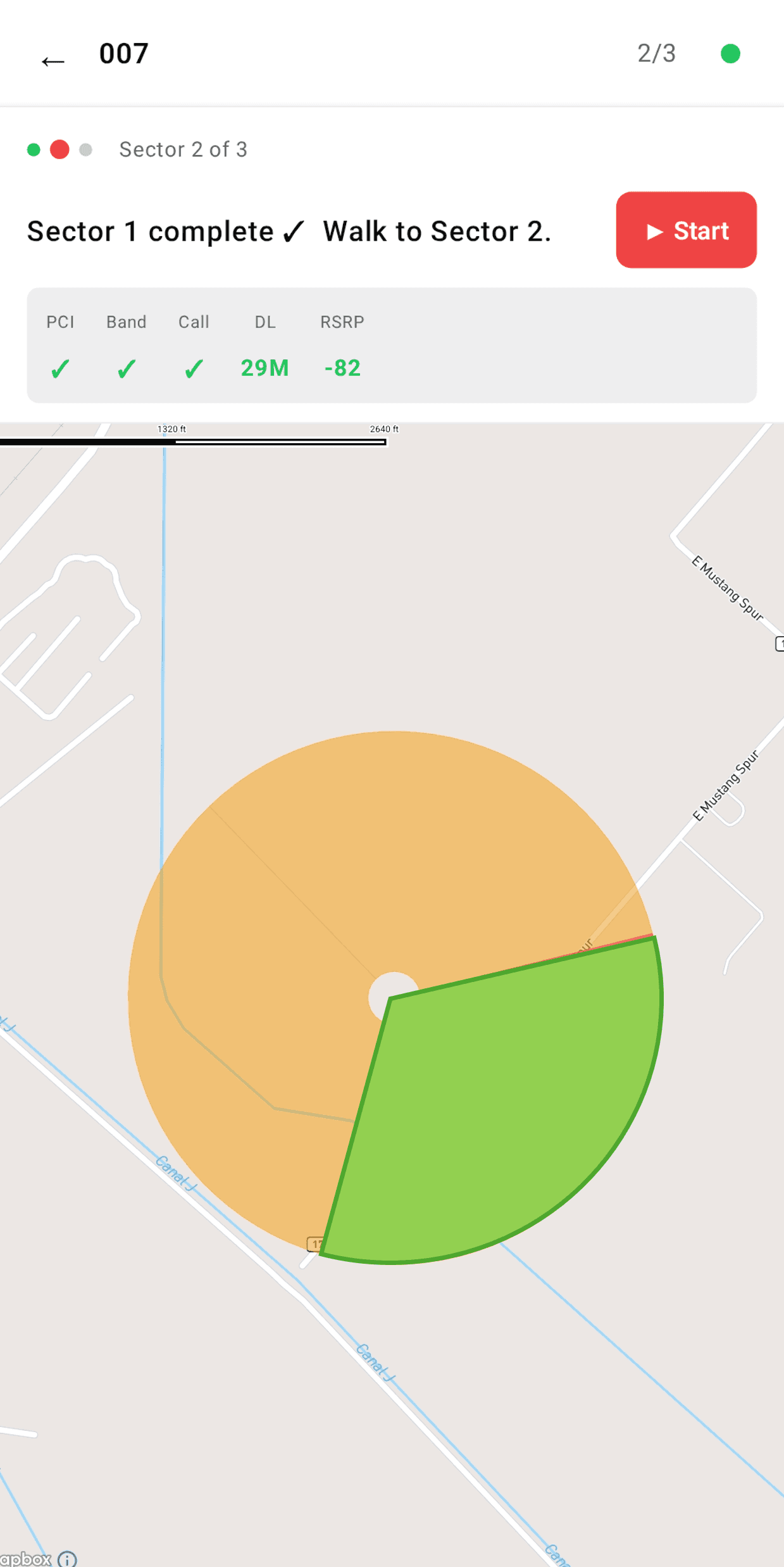
GC walks. Integrator reads.
The device shows the GC where to stand. Each sector turns green when its measurements are in. The integrator at the desk watches PCI, band, call setup, downlink throughput and RSRP stream in live — and flags anything wrong while the GC is still on the tower.
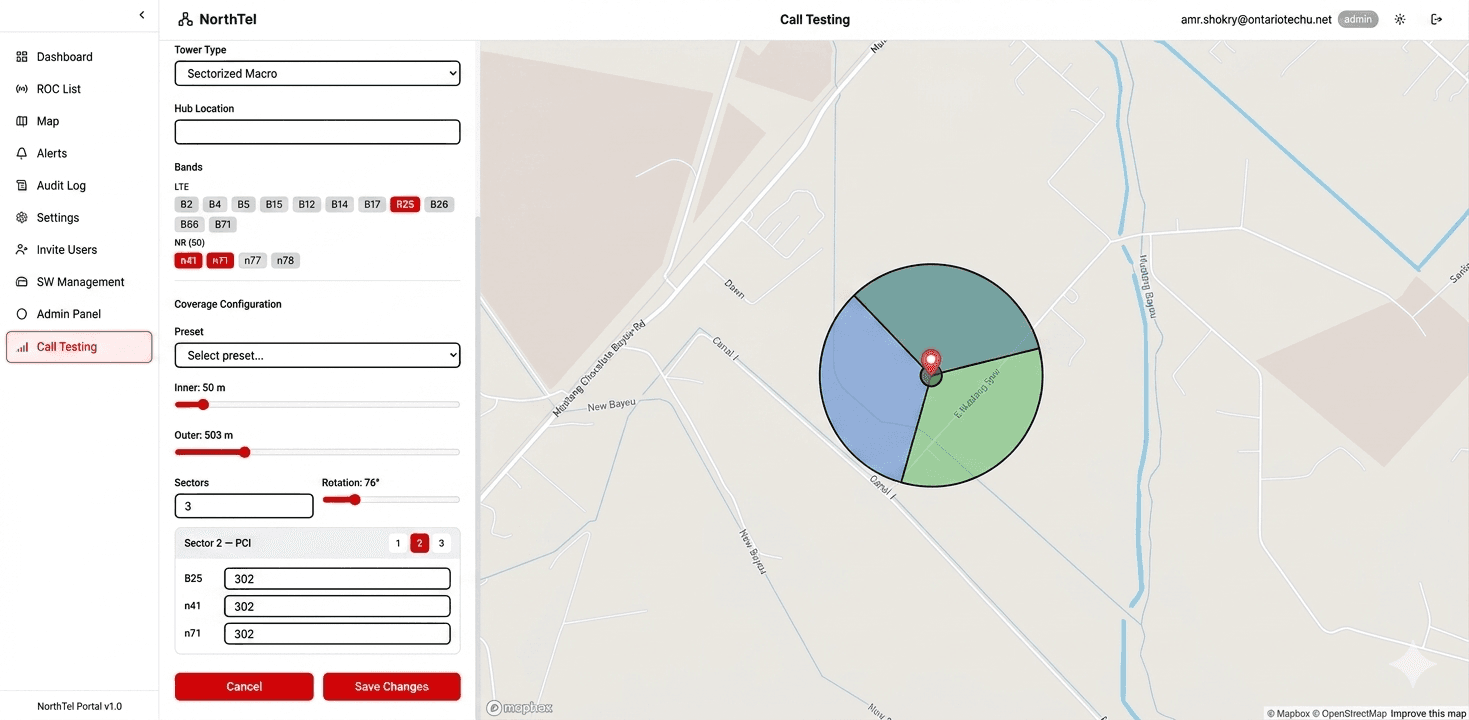
GC fixes it. Site is live.
Sector fails because two antennas are swapped or a fiber isn't seated? The integrator tells the GC exactly which jumper to check. The GC fixes it, re-walks the sector, the report writes itself, the site goes live — all in one mobilization.
Every site visit avoided is a safety win.
The industry is converging on a simple truth: fewer people on site means fewer incidents. NorthTel takes the integrator's visit out of the loop — fewer driving hours, fewer parking-lot hours, lower incident exposure per site live.
Built so it disappears.
The whole job of the call tester is to vanish into the workflow. Crew shouldn't think about the device — they should think about the site.
Zero training for the GC
A GC picks it up and runs the first walk that day. The integrator has the expertise; the device tells the GC where to stand.
No friction
No external probes to plug in, no laptop to boot, no app to configure per site. Power on, pick site, walk.
Live to the integrator
The integrator at the desk shadows the test in real time — flagging swapped antennas, loose jumpers and PCI mismatches before the GC leaves site.
Fix it on the spot
The integrator tells the GC exactly what to check — sector 2 antenna order, fiber on port 4 — so the physical fix happens in the same mobilization as the test.
Report writes itself
The portal builds the commissioning report as readings come in. Test history is auditable per site, per band, per device serial.
On the roadmap: self-diagnosis
Coming next: the device flags anomalies — antenna order, sector mismatch, PIM signatures — directly to the GC, no back office needed for the obvious cases.
Next: take the integrator out of the loop for the obvious failures.
Today the GC walks and the integrator diagnoses. Next, the device handles the common failures itself — swapped antennas, loose jumpers, sector mismatches — and tells the GC exactly what to fix without anyone watching from the desk.
v1 · GC walks, integrator reads
Multi-band, sectorized macro support. Live to the portal.
v2 · Self-diagnosis on device
Common failures flagged on the handheld. Integrator only steps in for edge cases.
v3 · Drone-mounted on truck
GC handles install. Drone walks sectors. Portal unchanged.
v4 · Fully autonomous bring-up
Integrator out of the loop entirely for standard site types.
Run a pilot at one site.
See what changes at every site.
Tell us about your bring-up calendar and a site you'd like to start with. We'll ship hardware and walk through the portal setup with your team.
info@north-tel.comTypical reply within one business day · NDA available on request